Recurring subscription burden
A carrier should not keep paying a large software fee forever simply because the initial implementation is complete.

One-time implementation
A setup built around your carrier
Separate carrier environment
Your company, your data, your workflows
Optional ongoing support
Choose the support your team needs
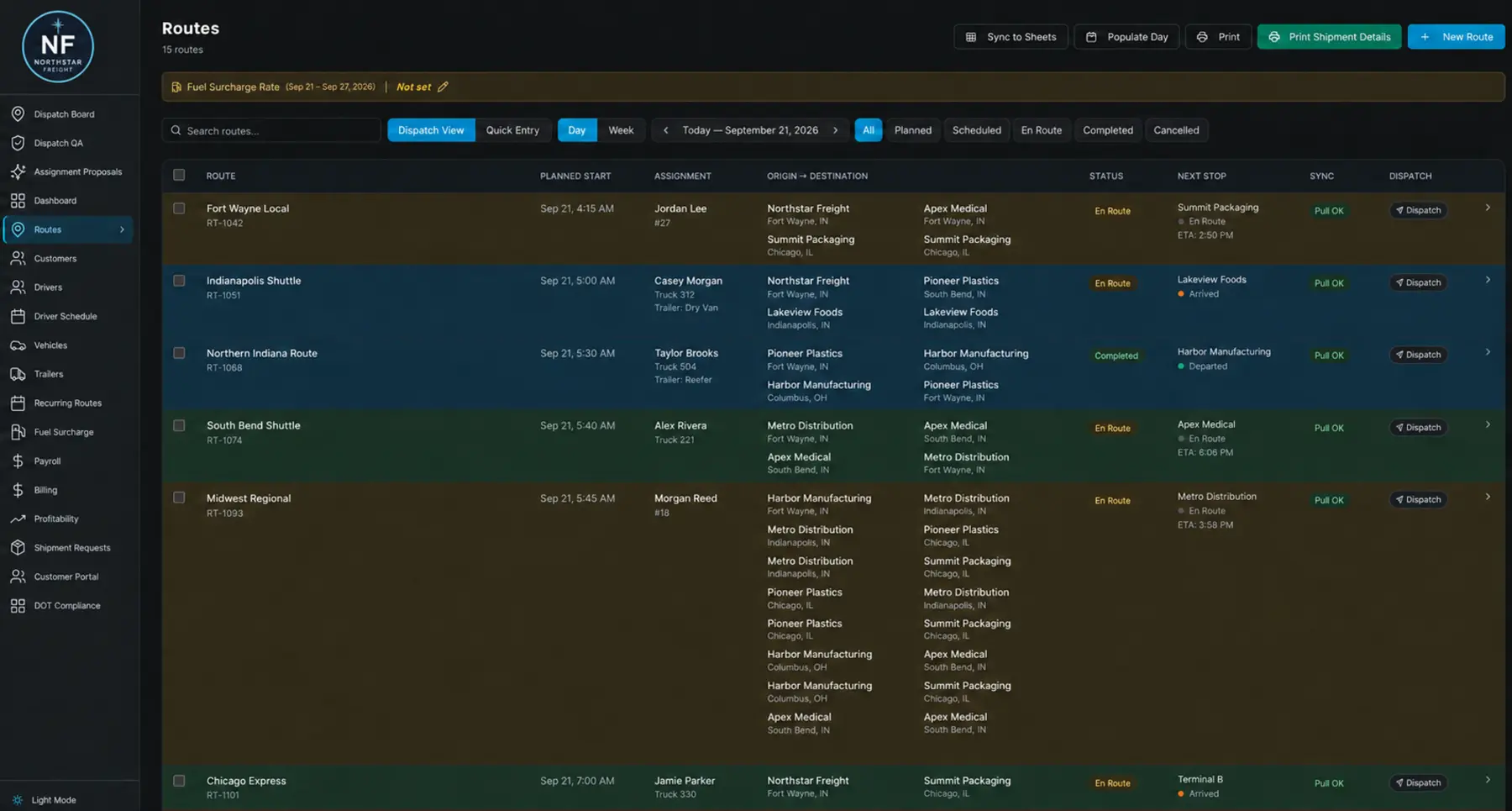
Dispatch command center
Plan recurring and one-time work, assign drivers and equipment, and follow stop timing and operational status in a workspace configured around your carrier.
Built after experiencing expensive recurring subscriptions, difficult implementations, rigid workflows, and oversized systems filled with features an operation may never use.
Early-adopter implementation
$8,500 one time
ELD and telematics integrations
Integration options can connect supported ELD and telematics data to your customizable trucking management software. Available data, write access, account requirements, and approval processes vary by provider.
Compatibility is confirmed before implementation. Provider names describe potential interoperability and do not imply endorsement or affiliation.
Why I created it
I created this platform from the perspective of an asset-based carrier. I understood the dispatch board, driver assignments, recurring routes, customer-specific billing, equipment decisions, and daily exceptions because I was already working through them.
The established TMS options were powerful, but they often came with a significant recurring subscription, a disruptive implementation, rigid workflows, and an overwhelming number of features we did not need.
I did not want the biggest system. I wanted the right system, one that could be configured around the way the company actually operates.
Every carrier gets a separate platform configured around its fleet, customers, terminology, processes, billing rules, and existing technology.
Fully customizable. Purposefully focused. Built from operations.
A carrier should not keep paying a large software fee forever simply because the initial implementation is complete.
The system should be mapped to the operation carefully, tested with real scenarios, and introduced without turning the business upside down.
Fields, screens, terminology, approvals, and billing logic should reflect how the carrier works instead of forcing every company into the same mold.
Carriers should not navigate dozens of modules they never asked for. The platform stays focused on the tools that create value for that operation.
Operational proof
The platform was shaped around an operating asset-based carrier with real routes, customers, drivers, equipment, billing rules, and daily exceptions. That operating environment became the first case study and the reason the product remains configurable instead of forcing every carrier into one model.
Case study foundation
One connected operating environment for dispatch, drivers, billing, equipment, and route profitability.
Recurring routes, one-time work, assignments, stops, timing, and exceptions were modeled from daily carrier operations.
Linehaul, mileage, fuel surcharge, accessorials, and customer references stay connected to the operational record.
Drivers, vehicles, trailers, route requirements, and mixed-fleet realities are treated as operating inputs, not afterthoughts.
Revenue, driver pay, miles, and operating assumptions can be reviewed alongside the work that created them.
The right fit
This platform is designed for asset-based teams with real operational exceptions, not brokerages searching for another load board or large fleets looking for a standardized enterprise rollout.
Asset-based carriers with approximately 10–75 vehicles
Dedicated, recurring, expedited, courier, local, or multi-stop operations
Mixed fleets using cars, vans, box trucks, tractors, and trailers
Teams already using an established ELD or telematics provider
Companies using QuickBooks Online or structured accounting exports
Carriers with customer-specific billing and reporting requirements
Carriers seeking customizable trucking management software without enterprise bloat
Product experience
Dispatch, driver workflows, billing, and profitability come together in one operating view configured around the way your carrier works.
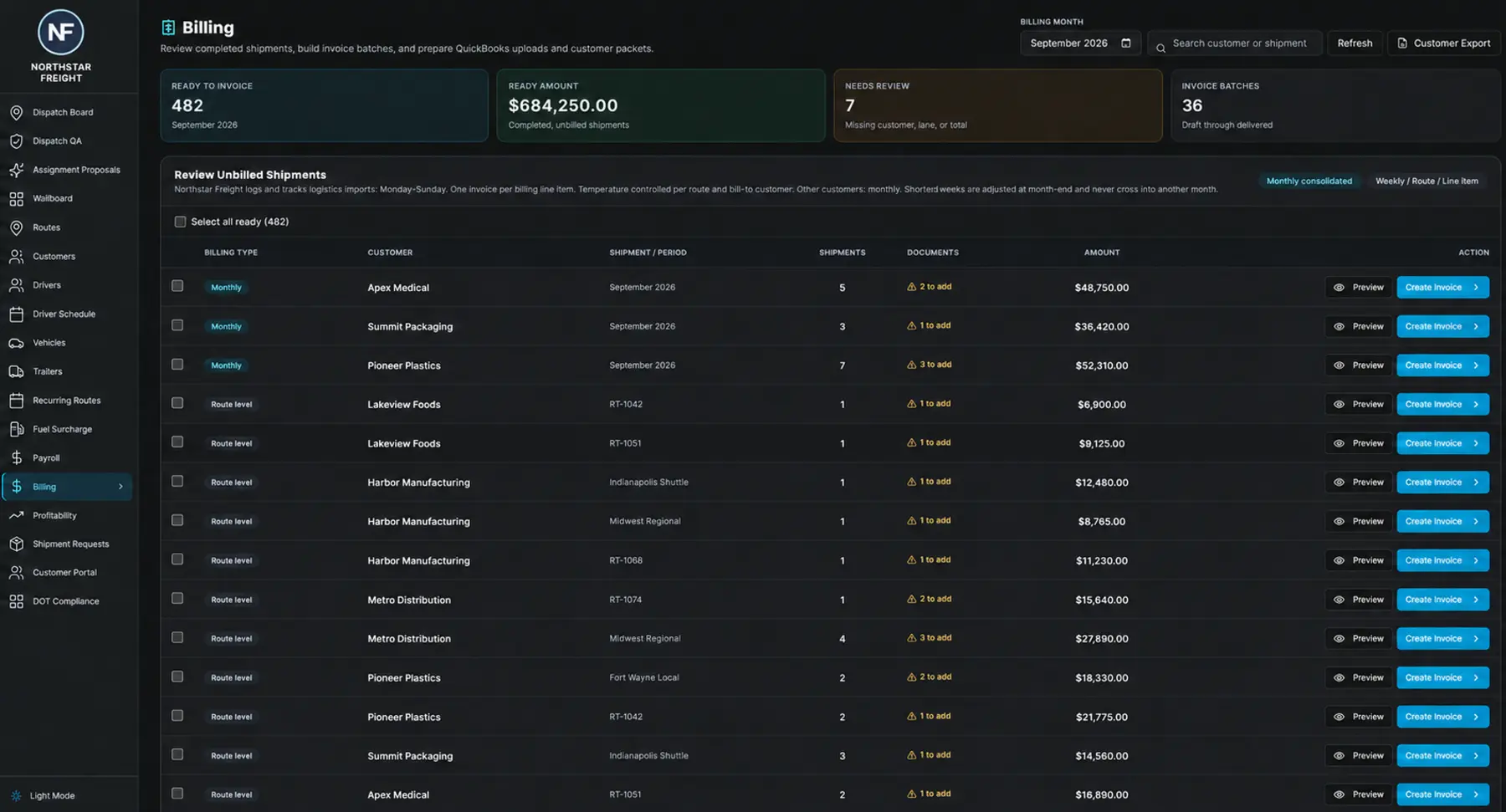
Invoice readiness
Turn completed work into invoice-ready customer billing with flexible billing periods, supporting documents, and clear review states.
Fictional demonstration data
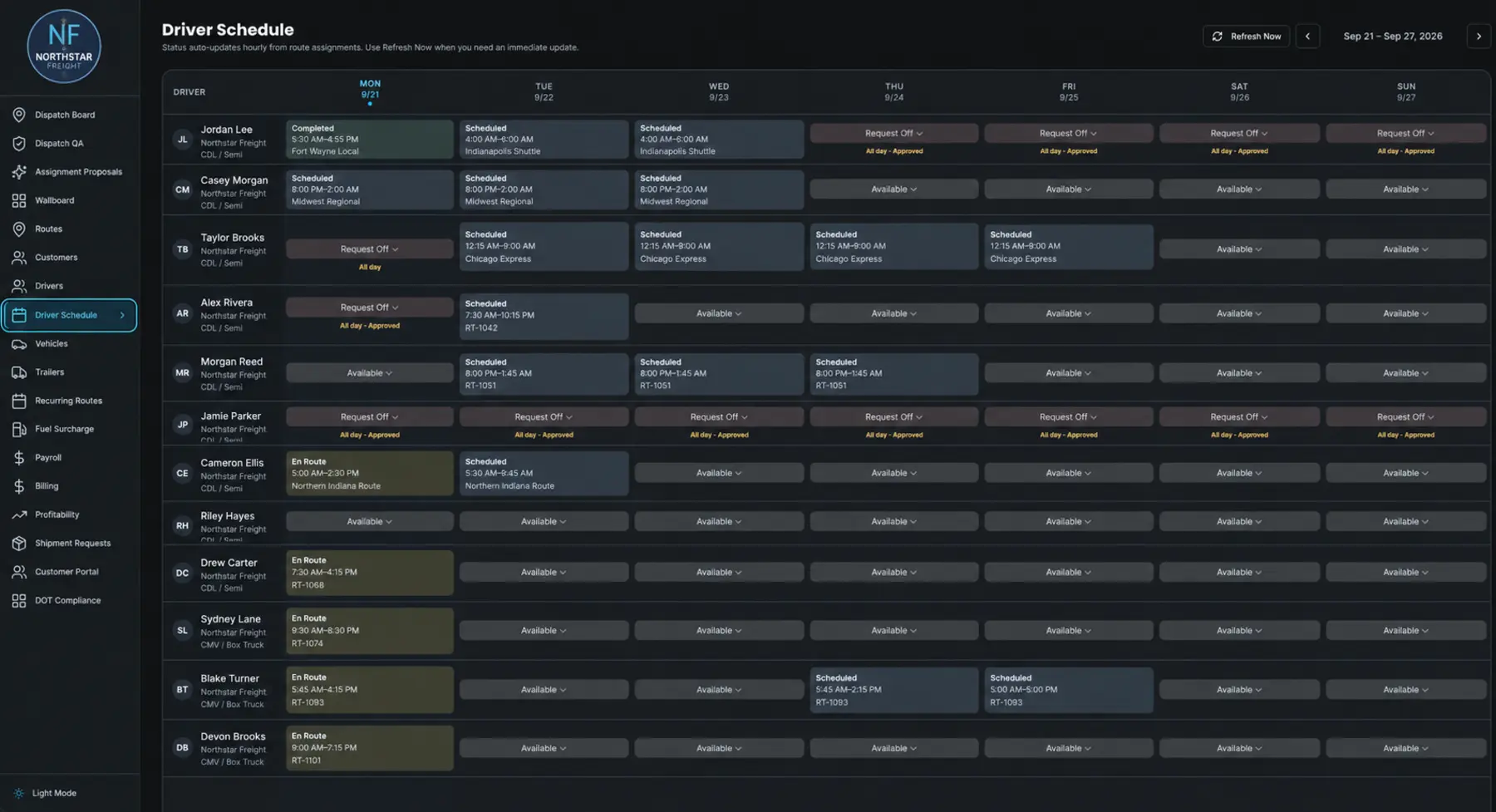
Schedule & availability
See availability, shifts, route assignments, and approved time off in one weekly planning view.
Fictional demonstration data
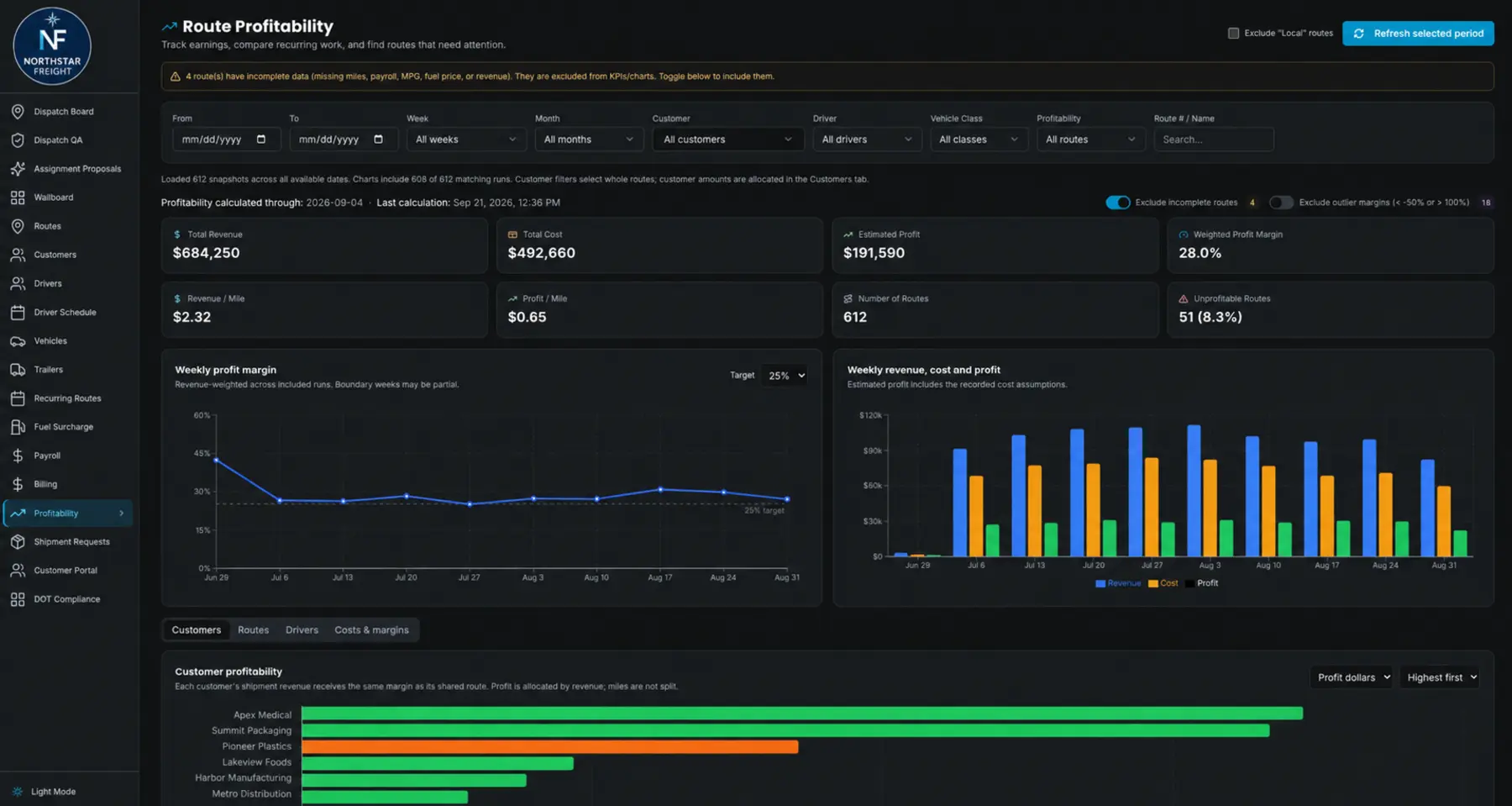
Revenue, cost & margin
Review revenue, operating cost, margin, and customer profitability alongside the work that produced it.
Fictional demonstration data
Core capabilities
Keep the tools you already trust while connecting the operational steps that create avoidable re-entry, delays, and missed information.
Configure recurring or one-time routes, multi-stop work, driver and equipment assignments, and daily exceptions inside a focused, customizable TMS workspace.
Connect your current ELD or telematics provider to reduce duplicate entry and keep route, vehicle, and operational data working together, subject to API compatibility.
Handle linehaul, mileage, fuel surcharge, accessorials, customer references, and specialized billing formats without forcing every account into one template.
Give authorized customer contacts secure, read-only access to their Bill-To shipments, including shipment details, current status, ETAs, documents, and invoice information.
Move approved invoice data into QuickBooks Online and keep shipment, billing, and accounting records connected without re-keying completed work.
Give drivers a clean mobile experience for schedules, route information, BOL details, signatures, and time-off requests.
Bring revenue, driver pay, total miles, billable miles, and operating assumptions together for clearer route-level decisions.
Automate repetitive steps while preserving manual overrides for the exceptions that are part of real freight operations.
Implementation pricing
The initial configuration is sold as a one-time implementation. Ongoing maintenance from Boutcher Digital Solutions is available, but it is not required.
Third-party costs
Application hosting and any domain, ELD, accounting, mapping, messaging, or API charges are paid directly by the carrier and are not included in the implementation fee.
Qualifying early adopters
Early-adopter implementation
$8,500
One-time implementation fee
Standard implementation
$13,000
Save $4,500
Typical launch scope includes
Early-adopter availability is limited to carriers that meet the operational and integration fit for the launch program. Final scope is confirmed before work begins. New or unusually complex integrations may require separate pricing.
A controlled rollout
We map how your dispatch, driver, equipment, billing, and customer workflows operate today.
Your environment is branded, configured, and connected to the systems included in the agreed scope.
Your team tests real scenarios, confirms exceptions, and validates the information that matters before launch.
We train your team, move the configured system into service, and provide post-launch implementation support.
Frequently asked questions
No. The platform connects operational workflows to a supported ELD or telematics provider. Your certified provider remains the system responsible for electronic logs and regulated ELD functions.
No. Each carrier receives a separate branded environment with its own data, credentials, users, workflows, and approved integrations.
The implementation is a one-time fee. Ongoing maintenance is optional. The carrier remains responsible for application hosting and any third-party platform, API, domain, messaging, or accounting costs.
Potential options include Samsara TMS integration, Motive TMS integration, Geotab TMS integration, Verizon Connect TMS integration, Omnitracs TMS integration, EROAD TMS integration, and Platform Science TMS integration. Available data, write capabilities, account requirements, and approval processes vary, so compatibility and scope are confirmed before the project begins.
Authorized customer contacts receive secure, read-only access limited to their Bill-To shipments. Depending on the configured scope, they can review shipment details, current status, ETAs, documents, and invoice information without access to another customer's data.
Yes. Approved invoice data can be sent to QuickBooks Online using carrier-specific customer, item, and billing mappings. QuickBooks remains the accounting system of record, while the TMS keeps the operational and billing details connected to each shipment.
Early-adopter projects must be a strong operational and integration fit, stay within the defined launch scope, and participate in structured feedback during implementation.
Many TMS products begin with a standardized feature set and ask the carrier to adapt. Winnie TMS Freight Platform is configured around the carrier's terminology, dispatching workflow, billing rules, equipment, customers, and supported integrations. It is customizable trucking management software and customizable dispatching software built for the operation using it.